

Clients are starting to discover freelancers through a broader mix of channels, including AI-powered search experiences that help them ask more specific questions, compare options faster, and form an opinion earlier.
In Google Search Central’s “AI Features and Your Website”, Google explains that AI Overviews and AI Mode are part of Google Search and help people explore more complex questions. In OpenAI’s “Introducing ChatGPT Search”, OpenAI describes ChatGPT Search as a way to get fast, timely answers with links to relevant web sources. Bain & Company’s 2025 research adds the commercial context: about 80% of consumers rely on zero-click results for at least 40% of their searches, reducing organic web traffic by an estimated 15% to 25%.
It is no longer enough to appear in front of a buyer. Your online presence has to explain your offer, support trust, and give a client enough substance to keep going.
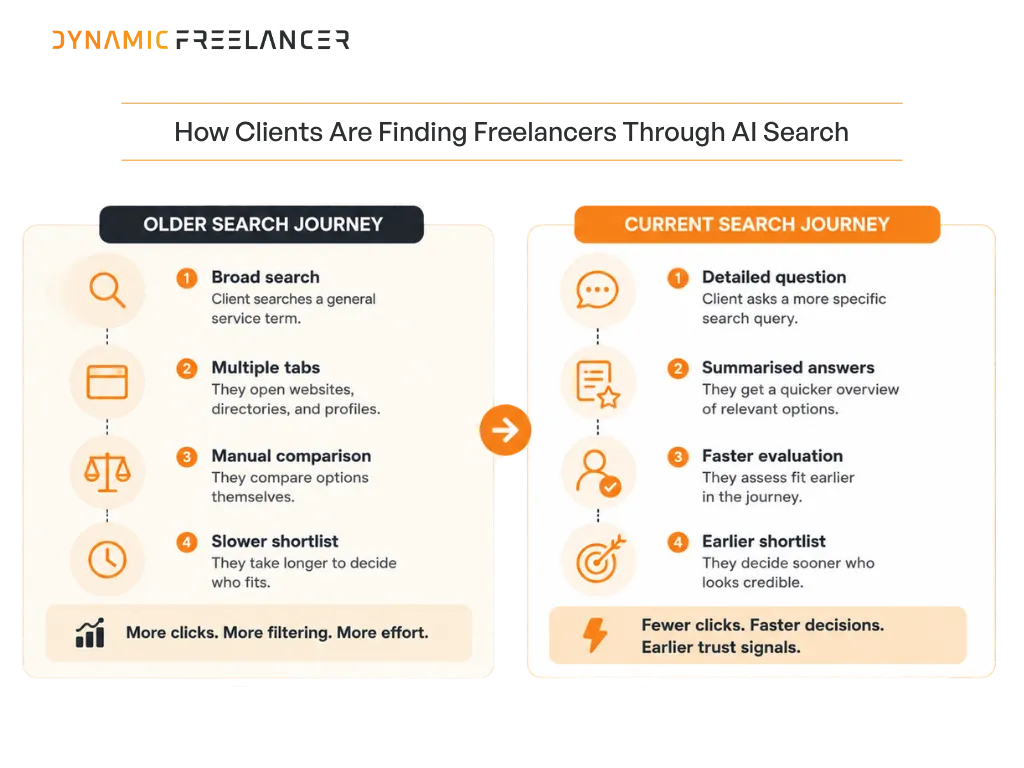
Discovery is becoming more compressed. Clients are reaching conclusions earlier in the journey, which means first impressions now carry more commercial weight than before.
Search visibility and buyer confidence are becoming more closely linked. Being found is no longer separate from being trusted. The same signals that help a freelancer surface are often the ones that help a client feel ready to enquire.
Freelancers with stronger market clarity will have an advantage. As search becomes more specific, professionals who can be understood quickly in a business context will be easier to evaluate and shortlist.
Professional structure is becoming part of competitive positioning. In markets like the UAE, credibility is shaped not only by skills and proof, but also by how professionally a freelancer can operate from the first client interaction.
Why Client Discovery Is Becoming More Specific
The older search journey gave broad exposure to broad profiles.
A freelancer could rank for a wide term, add a short bio, and still attract interest. That route is weaker now because the search itself carries more context. A client can ask for a copywriter for a law firm, a designer for a hospitality brand, or a consultant in Dubai who can work with corporate teams. Google’s “AI Features and Your Website” explains that these search experiences are built to help people with more complex questions, not only short keyword lookups.
That changes what a strong freelancer profile looks like.
A broad message asks the buyer to do too much work. It gives them very little to assess. A focused message gives them a stronger reason to stay on the page and compare you with confidence.
What Clients Are Judging Before They Contact You
Before a client sends a message, they are already deciding whether you fit the brief.
In practice, many clients will assess five things early in the journey:
Service fit
Sector relevance
Proof of work
Professional presentation
Business readiness
This is where many freelancers lose ground.
Their work can be strong, yet their digital presence is too thin. The website is broad. The portfolio has no context. The LinkedIn profile uses one message while the service page uses another. The result is friction. The buyer cannot see where that freelancer fits best.
Search tools cannot solve that gap for you. They can only work with what you publish.
Why Specialist Positioning Carries More Weight
As search becomes more question-led, specialist positioning is often easier for buyers and search systems to understand.
A profile that says “freelance marketer” could mean almost anything. A profile that says “email copywriter for ecommerce brands” gives the buyer something far stronger. It reduces doubt. It helps them decide whether your experience fits the work they need done.
This does not mean every freelancer should shrink into one rigid label. It means your public presence should reflect how clients buy. Most clients do not hire “creative support” or “digital help”. They hire a service for a business problem.
That is one of the strongest lessons in this shift. You do not win attention through vague positioning. You win it by showing where your work fits.
Why Service Pages Deserve More Attention
A homepage can introduce you.
It rarely does enough to support a buying decision.
Clients want pages that speak to the service they need. They want to know what the service includes, who it is for, what problem it solves, and why you are a strong fit to deliver it. In Google Search Central’s “Optimizing your website for generative AI features on Google Search”, Google states that generative search features are rooted in its core Search ranking and quality systems, and that standard SEO best practices still apply.
That point is important for freelancers.
In this environment, a website that works like a digital business card is weaker than a website that works like a real sales asset. Depth helps. Specificity helps. Pages built around buyer questions help.
Why Proof Is Carrying More Weight
Proof has always influenced hiring.
Now it starts doing that job earlier in the journey.
A buyer who reaches your portfolio or service page wants evidence that lowers the risk of choosing you. The strongest proof does not only show the final output. It explains the brief, the challenge, the thinking, and the result.
Some of the strongest trust-building assets in this environment are:
Case studies
Testimonials
Portfolio samples
Project summaries
Measurable outcomes
This is where many freelancers still underuse their best material.
Their portfolio shows the work, though not the thinking behind it. Their testimonials praise them, though they say very little about results. Their service page lists deliverables, though does not connect those deliverables to business value. A buyer wants more than evidence that you can produce work. They want evidence that you understand the problem they are trying to solve.
Why Your Digital Footprint Needs To Match
Freelancers are rarely judged through one touchpoint alone.
A client can reach your website first, then check LinkedIn, then review your portfolio, then scan social channels. When those platforms describe you in different ways, trust drops. The issue is not branding alone. The buyer cannot form a strong picture of what you do best.
A consistent digital footprint gives buyers a clearer picture of your offer.
The wording does not need to match line by line, though the position should. Your website, LinkedIn presence, service pages, and portfolio should all support the same central offer. That consistency helps buyers understand you faster, and it gives search systems a stronger signal about your relevance.
Why it's Relevant to Freelancers in the UAE
For freelancers in the UAE, professional credibility carries extra weight.
Clients are not only looking at your skills. They are also looking at how ready you are to work with them in a business setting. They want confidence that the engagement will feel structured from the start.
That often shows up through a few practical signals:
Compliant freelance setup
Invoicing support
Professional client process
Credible business presence
In the UAE market, business-readiness can strengthen the credibility signals clients use when deciding whether to shortlist a freelancer.
A strong setup supports trust. It helps a buyer feel that you can work in a professional way, issue invoices properly, and handle client relationships with structure. Dynamic Freelancer positions its service around that foundation, with sponsorship support, invoicing support, client management tools, and legal work authorisation across the UAE.
What Freelancers Should Take From This
The opportunity here is not to chase every new feature.
It is to become easier to trust and easier to understand.
Freelancers who perform well in this environment tend to share the same strengths. Their positioning is focused. Their service pages are stronger. Their proof has substance. Their public profiles support the same message. Their business presence feels established.
That is good news for serious freelancers because these are assets you control.
You do not need a huge audience to improve them. You need a stronger presentation of the work you already do.
Final Thoughts
As search becomes more answer-led, clients can compare options sooner and make earlier judgments based on relevance, proof, and trust. Google’s search documentation, OpenAI’s search product notes, and Bain’s market research point to the same broader shift: search is becoming more answer-led, which gives buyers faster ways to assess options.
Freelancers who sharpen their positioning, deepen their service pages, strengthen their proof, and present themselves professionally will put themselves in a stronger position to be found and shortlisted.
For freelancers in the UAE, that also includes building a setup that supports credibility from the first client conversation.
Frequently Asked Questions
Find answers to common questions about this topic
What is AI search and how does it affect freelancer visibility?
Why is niche positioning important in AI search?
How can freelancers enhance trust signals in their profiles?
What role does LinkedIn play in freelancer discoverability?
How can freelancers in the UAE improve client confidence?
Disclaimer: This article is intended to provide practical, up-to-date information. Details may vary based on individual circumstances, location, or changes in regulations. The information provided is for informational and educational purposes only.